
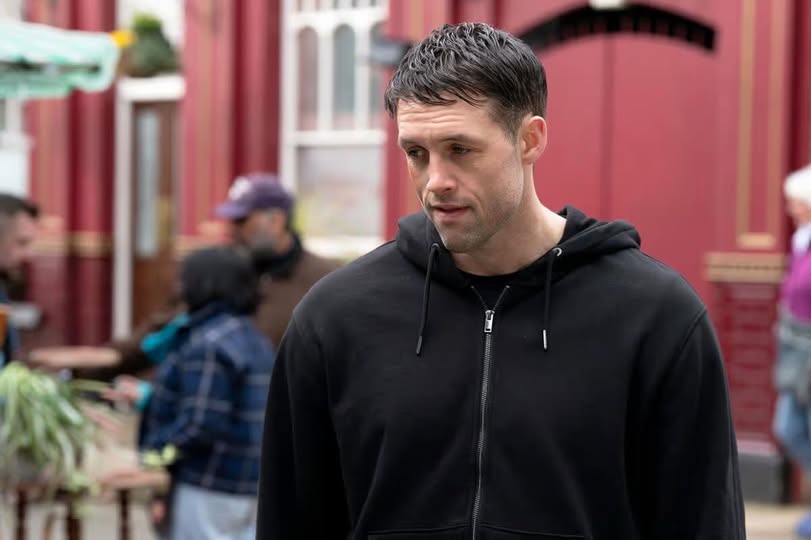
EastEnders- Mark is beaten up & Sam suggests he should ask Grant for money
The foggy banks of the Thames have long served as a backdrop for the fractured legacies of the Mitchell clan, but the atmosphere in Walford has reached a high-octane breaking point as a long-buried truth and a looming debt threaten to ignite a war that not even Phil can finish. Mark Fowler Jr., a man currently defined by the bruises on his face and the crushing weight of a predatory debt, found himself slumped on a park bench, the physical and emotional toll of his life in the East End finally catching up to him. The air was thick with the scent of unwashed trauma and street-level desperation as Sam Mitchell, acting as the unexpected “Auntie” and moral anchor, cornered him in a moment of raw vulnerability. After being unceremoniously tossed from a moving vehicle—a brutal “Corriedale” style reminder of the world he now inhabits—Mark was forced to confront the reality that his “Zero-Footprint” strategy for surviving London was a failure. The mention of Delaney, a shadow from the Square’s past who once utilized violence as a primary negotiation tactic, acted as a rhythmic trigger for Sam’s own memories, bridging the gap between the Mitchells’ dark history and Mark’s terrifying present.

The psychological landscape of the conversation shifted from the immediate threat of physical harm to the much more complex, internal war regarding identity and the weight of a name. Mark’s insistence that he would never ask Grant Mitchell for a single penny revealed a landscape of pride and resentment that has been decades in the making, a stubborn refusal to acknowledge the man who stands as his biological architect. Despite the crushing debt and the looming threat of Russell’s enforcers, Mark remained anchored to a decision he made years ago, viewing any help from Grant as a betrayal of his own autonomy. However, Sam, moving with the grounded empathy of a woman who has survived her own Mitchell-sized storms, challenged this stagnant worldview with a masterclass in emotional persuasion. She didn’t speak of Grant as a legend or a “commando copper” with a reputation for brutality; instead, she spoke of him as a man she had seen “in action,” a man who possesses a visceral, protective energy that could level any obstacle standing in Mark’s path if only the prideful young man would allow the connection to forge.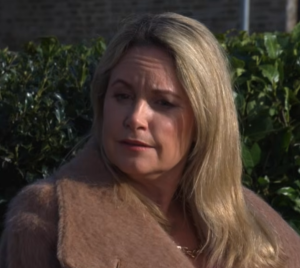
The atmospheric tension reached a breathtaking peak as Sam delivered the ultimate narrative bombshell: the realization that while Mark refuses to see Grant as a father, Grant Mitchell firmly and unequivocally sees Mark as his son. This “meta” revelation about the Mitchell psyche stripped away the pretense of the “tough guy” facade, exposing a vulnerable, patriarchal longing that has been the silent heartbeat of Grant’s return to Walford. The contrast was stark; while Phil Mitchell has “helped enough” and washed his hands of the financial rot, Grant is standing in the wings, armed with the resources and the raw desire to protect his bloodline from the predators in the shadows. To Sam, the money was merely a catalyst, a functional necessity to get Delaney off Mark’s back, but the true stakes were existential. She was advocating for a reunion that would redefine the Square’s power dynamics, urging Mark to recognize that times have changed and that the sanctuary he so desperately needs is currently being offered by the very man he spent a lifetime trying to ignore.
As the dusk settled over the park, the “mustache energy” of the old-school Mitchell dominance felt more like a protective shroud than a threat, as Sam pushed Mark to accept a reality that would forever alter his place in the family tree. The legacy of Grant Mitchell is one of blood, fire, and an uncompromising loyalty to those he claims as his own, and Sam’s insistence that Mark is already part of that inner sanctum was a lifeline thrown into a sea of debt. The irony of the situation was palpable; Mark is a man fighting for his life against a street-level thug like Delaney while a titan of the East End stands ready to unleash hell on his behalf. It is a story of a son running out of time and a father running out of patience, a generational collision that promises to be as biblical in its proportions as it is intimate in its heartbreak. Every “shoddy” parenting decision Grant made in the past was being weighed against this singular moment of redemption, a chance to prove that the Mitchell name is a shield, not just a target.
Ultimately, the question hanging over the bench wasn’t whether the money would be found, but whether Mark Fowler Jr. could survive the ego-shattering transition from a lone wolf to a Mitchell son. If he chooses to remain in the shadows of his own pride, Delaney’s next move might be his last, but if he accepts the “Grant solution,” he invites a level of protection—and a level of expectation—that will redefine his soul. Sam’s honest, unvarnished guidance served as the final push, a reminder that the most important thing in a world of violence and debt is the knowledge that someone truly wants to help. As the credits loom on this chapter of the Mitchell saga, the viewers are left in a state of high-octane suspense, wondering if the next knock on Mark’s door will be the fist of a debt collector or the hand of a father coming home to roost. The endgame for Mark’s survival is officially in motion, and the fallout from his decision will likely be the most explosive, heartwarming, and quintessentially Walford story the Square has seen in years, proving once and for all that while you can run from a name, you can never truly outrun the blood that defines you.