
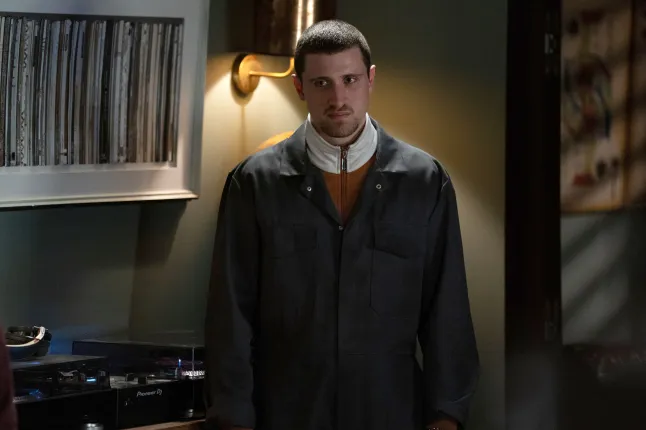
EastEnders- Harry wants Nicola to send Eddie away after seeing how upset Gina is
The domestic arena has transformed into a high-pressure crucible where the weight of moral compromise is systematically dismantling the relationships that once held the family together, leaving every member caught in the crossfire of resentment, survival, and the sickening stench of betrayal. At the heart of this collapse is the staggering discovery of a secret kept in the shadows—a choice to harbor a man whose presence is an affront to their values, made not out of malice, but out of a desperate, clawing need to maintain the material comforts of their existence. The confrontation that erupts is not merely a dispute over household dynamics or a clash of opinions; it is a profound indictment of a mother’s decision to prioritize financial stability over the integrity of the home, forcing her loved ones to reconcile the person they thought they knew with the cold, calculating strategist she has been forced to become. The dialogue, heavy with the sharp, jagged edges of unvarnished truth, exposes the deep-seated hypocrisy of an arrangement where the ends are meant to justify the means, yet the means themselves—inducting a bigot into their sanctuary—are eroding the very foundations of the life they are trying to protect. The silence that usually permeates their shared space has been replaced by the screaming reality of what has been sacrificed, leaving the viewer to witness the agonizing intersection of love for one’s children and the total, irreparable loss of one’s own moral compass.

The justification offered—a frantic, tear-stained defense of doing “everything for the family”—acts as both a shield and a sword in this domestic war, highlighting the tragic, age-old struggle between the preservation of the unit and the corruption of the individual. To hear a mother articulate that she is “swallowing a pill” by hosting a man she despises, all to ensure that her children do not return to the “bottom of the barrel,” is a scene of profound human complexity that defies a simple black-and-white interpretation. It forces the audience to confront the unsettling question of how much one is truly willing to endure, or how much one is willing to sell, to keep the lights on and the future secure in a world that offers no safety net for the fallen. The mention of a mixed-race daughter adds an extra, agonizing layer of dissonance to the mother’s compromise, painting a portrait of a person who is acutely aware of the harm she is inviting into her home, yet is pathologically convinced that her sacrifice is the only viable path to avoid total ruin. This is the heart of the drama: the collision between a parent’s primal, often irrational protective instinct and the societal necessity of holding onto one’s humanity when the environment demands a hardening of the soul.
As the argument spirals, the focus shifts to the collateral damage of this choice—the way it warps the perception of loyalty, safety, and respect among those living in the house. The daughter’s sense of betrayal, the feeling that she has become a “second thought” in a house where her mother is pulling the strings, is not just a reaction to a singular lie; it is a realization that her mother’s reality is now defined by a transactional logic that leaves no room for the vulnerability and trust that used to define their bond. To be told that “he’s going to be dead soon” as a way to rationalize the current nightmare is perhaps the most chilling aspect of the exchange, signaling a grim, pragmatic outlook that treats a human life as a temporary, albeit repulsive, commodity. This casual dismissal of their guest’s humanity, combined with the mother’s desperate attempt to keep the charade alive, creates a sense of profound claustrophobia, where the audience, like the children, feels trapped by the mother’s “choice” that was never actually theirs to accept. The air in the house is thick with the scent of this decision, turning the home from a place of refuge into a battlefield where the weapons are memories, accusations, and the bitter, suffocating knowledge that everything they own is bought with the currency of their own dignity.
The interaction also serves as a masterclass in the breakdown of trust, as the daughter realizes that the man who should be her ally, who she believed was protecting her, has been complicit in the very web of deceit that is destroying her family from the inside out. The question of why the father cannot simply “put his foot down” is met with the uncomfortable realization that he, too, is a product of this same, desperate environment, his hands as tied by the phantom of poverty as his wife’s. Their mutual inability to stop the descent is not because they lack love, but because they have become addicted to the stability they are now terrified of losing, a cycle of fear that has made them blind to the fact that the house is already empty, despite the walls still standing. The mother’s laughter at the end of the argument, a sharp, dissonant sound that cuts through the tension, is the most terrifying beat of the entire narrative—it is the sound of a woman who has finally realized that she has moved past the point of rationalization and into a state of total, fatalistic resignation. She is no longer trying to convince them; she is simply stating the terms of their survival, leaving the others to choose whether to stand in the ruin of their values or to walk away into the uncertainty of a life without the protection of the wealth she has clawed for. 
Ultimately, this explosive showdown leaves the viewer with the haunting reality that in the struggle for survival, the most dangerous enemies are not the ones we let through the front door, but the compromises we make to keep them there. The house is a hollowed-out shell, a stage for a tragedy that is as old as the human experience: the tragic irony of sacrificing the essence of a home—its safety, its integrity, its love—in the vain, desperate hope of securing its physical existence. As the story unfolds, the audience is left to grapple with the chilling certainty that there is no “catastrophe averted” here, only a catastrophe deferred, as the rot of their secret will continue to spread until it consumes the very people they were trying to shield. The finality of their situation—the realization that they are drowning in a debt that is not just financial, but moral—proves that the most damaging poverty is the one that forces us to become the very people we spent our lives despising. The stage is set for a continued unraveling, where the only thing left to save is the truth, yet even that seems to have been traded away for a few quid and the desperate, empty comfort of a life that is no longer truly their own.