
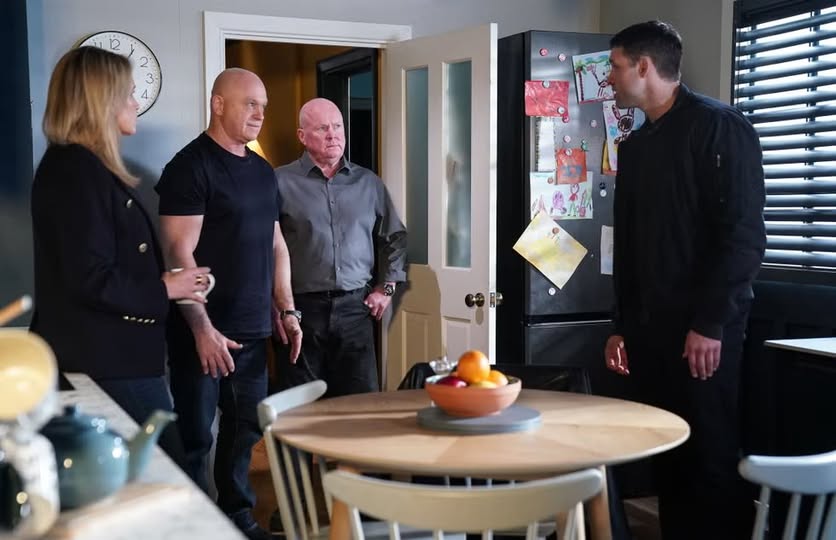
EastEnders- Russell Delaney and Grant Mitchell punch eachother
EastEnders- Russell Delaney and Grant Mitchell punch eachother
The fragile truce between the past and the present has been violently shattered in a confrontation that serves as a grim masterclass in the devastating consequences of pride, long-held resentments, and the toxic inability to navigate a crisis without resorting to the archaic, destructive language of violence. When Grant Mitchell stepped back into the orbit of Russell Delaney after thirty years of silence, the intention was a simple, albeit desperate, plea for mercy on behalf of his son, Mark, whose mounting debts threatened to consume him. Yet, the air between them was immediately heavy with the static of unresolved history, a landscape scarred by the ultimate betrayal—Russell’s past infidelity with Grant’s wife, Joanne—which transformed what should have been a strategic negotiation into a volatile arena of emotional warfare. Grant’s attempt to project the authority of a man who still commands the streets was met with the cold, cynical laughter of an adversary who no longer recognizes the hierarchy of their youth, turning the meeting into a disaster of operatic proportions. The tragedy of the encounter lies in Grant’s fundamental miscalculation: he approached Russell as an old friend who could be swayed by a “favor,” oblivious to the fact that the man sitting across from him has spent three decades waiting for the exact opportunity to dismantle the legend of the Mitchell name.
The conversation rapidly spiraled into a nightmare when the transactional nature of their business—the extension on Mark’s debt—was hijacked by the ghosts of their personal failures, leading to a reveal that was as predictable as it was agonizing. The dredging up of the marital bed betrayal was not merely a side note; it was the sharp, jagged blade that cut through the remaining shred of diplomatic decorum, forcing a collision between Grant’s defensive posturing and Russell’s cold-blooded realization that his leverage had just doubled. Grant’s desperate insistence that his son would not pay a single penny, fueled by a reflexive, aggressive refusal to accept the reality of the situation, was the final, fatal error in a chain of mistakes that left Russell with no incentive to offer leniency. The power dynamic shifted in an instant, as the man who came seeking an extension instead inadvertently authored the death warrant for the very person he was trying to save, demonstrating the chilling reality that in the underworld, your reputation is often your most significant liability. The scene stands as a stark, brutal testament to the danger of bringing personal vendettas into professional crises, proving that when the two are allowed to merge, the result is almost always a catastrophic unraveling of the very life one is trying to protect.

As the confrontation reached its breaking point, the atmosphere in the room shifted from simmering tension to the cold, clinical finality of a death sentence, with Russell delivering the ultimatum that would redefine the trajectory of the Mitchell family forever. The demand to double the debt, combined with the chilling, time-stamped promise to kill Mark if the payment was not met, served as a horrifying reality check for Grant, who watched his own bravado collapse in real-time. The silence that filled the space between them was absolute, a void where Grant’s authority once stood, now replaced by the grim knowledge that his own hands had pulled the trigger on his son’s survival. It is a moment of profound, paralyzing irony: the father who prided himself on being the ultimate protector has become the architect of the greatest threat his child has ever faced, forced to grapple with the terrifying truth that his own inability to swallow his pride has exacted a price that no amount of money could ever repay. The cold, calculating look in Russell’s eyes as he laid out the new terms was the look of a predator who has finally cornered his prey, ensuring that the burden of the coming tragedy will rest entirely on the shoulders of a man who now has to return home and look his son in the face.
The immediate aftermath—the agonizing, suffocating reality of what Grant has done—is a narrative climax that highlights the deep, systemic rot within the Mitchell clan’s approach to solving their problems. The question posed to him—”Are you happy now, mate? You satisfied? You just put a hit on your own son?”—is the ultimate indictment of a life built on the premise that strength is defined by the ability to hold your ground regardless of the cost. Grant’s silence, a desperate, crumbling retreat from the gravity of his actions, underscores the total failure of his philosophy, as he is forced to confront the wreckage of his intervention. He came to reason, to negotiate, and to save, yet he leaves with the burden of knowing that his very presence, his words, and his outdated need to “let his fist do the talking” have turned a manageable crisis into an irreversible, blood-soaked disaster. It is a haunting, visceral exploration of the limits of influence, showing how even the most feared man in the room can be reduced to a hollow, broken shell when his bravado is met with the calm, lethal reality of an opponent who no longer fears him, and who has no interest in playing by the rules of the past.
Ultimately, we are bearing witness to the tragic, inevitable conclusion of a life lived in the shadows of one’s own ego, where the desire to maintain the facade of power has finally caused the structure itself to collapse. The confrontation between Grant and Russell is not just about a debt; it is about the death of a myth, the final, humiliating realization that the world has moved on while the Mitchells remained frozen in a cycle of aggression that is no longer effective, but is now actively lethal. As Grant prepares to face the fallout of his meeting—the terrifying task of explaining to Mark why the stakes have suddenly and impossibly spiked—the audience is left with the chilling certainty that the safety of the household has been permanently compromised by the very man who vowed to guarantee it. The Mitchells are standing on the precipice of a final, explosive reckoning that will demand the ultimate price from everyone involved, regardless of their role in the deception or their distance from the initial debt. The viewers are left to grapple with the realization that the peace of their domestic existence was always a fragile, conditional state, and that the only way to truly survive the next week would be to abandon the pride that has brought them to this brink, yet the tragic, heartbreaking irony is that they are likely incapable of doing so, ensuring that the cycle of destruction will continue until there is nothing left to lose.